Wednesday, March 14, 2012

End of an Era


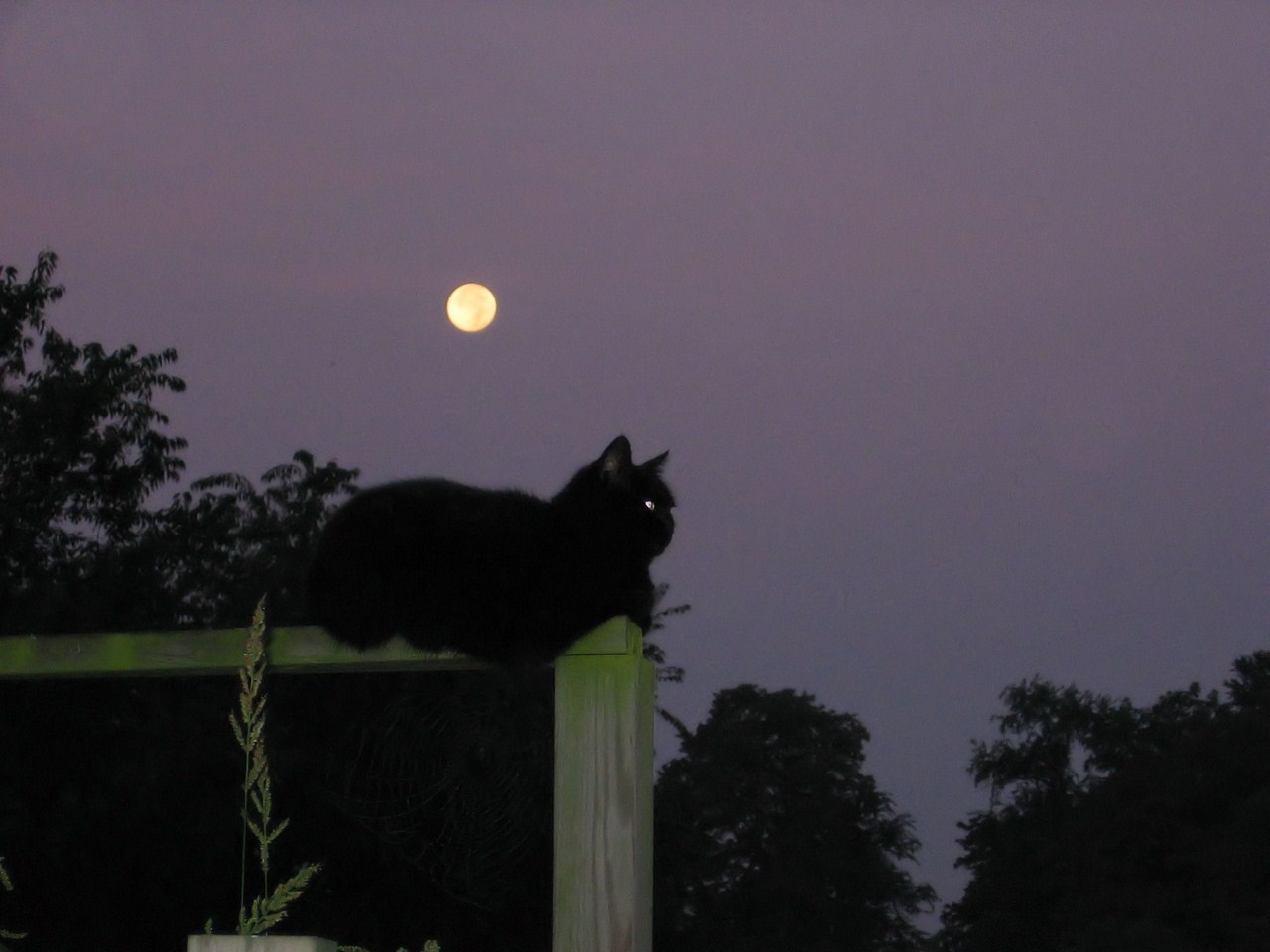
It’s time to admit it…she’s gone. As mysteriously as she appeared all those years ago, she has now disappeared. I need to get beyond expecting to find her somewhere. She’s just gone. Gone, but not forgotten.

I guess I should begin at the beginning...

It wasn’t too long after we moved here on the hill that we saw her for the first time. A small, black cat was stealing a piece of buttered bread from the bucket of scraps for the chickens on the back porch. It didn’t matter to her that the homemade butter was way “past its prime” and someone had decided it wasn’t worth eating. No, this kitty was very pregnant and very hungry.

We saw her more often as it got closer to the time for the kittens. She became my little companion in the milking stall, waiting patiently for me to fill her small bowl with milk when I was finished my task. I learned that despite what you hear, or see in the movies, some cats do NOT like to be squirted with milk.

She became a permanent barn fixture and had her second batch of kittens INSIDE the stack of hay bales. Later, as they came out of their kitty nest, you could see their little eyes peering out curiously through the bales. As they became bigger, they tumbled out, playing endlessly as only kittens can. We kept a couple of the kittens to be barn kitties with their mom. A trip to the vet put an end to the “kitten factory”.


With kitten rearing behind her, Miss Kitty was a regular part of the farm team. She would follow me to any part of the garden and sit and “talk” while I worked. Sometimes she would complain, other times she would just “mert” in a contented way. If she got hot, she would lie down under the shade of the plants until I was finished, and then escort me to the next job. The girls often referred to her as the supervisor, because she would invariably show up for any outside job with some type of comment.

She outlived her offspring, and then became house cat for a while. In the midst of a very cold, snowy spell, she was bitten by something and both her eyes were swollen shut. The Boss took pity on her and she came inside.
She got used to it very quickly, and kept my feet warm on many a cold night. Actually, she kept everything warm. It was amazing how something so small could generate so much heat.

Eventually, she moved back outside; where she took charge of the barn once more. There never was a mouser like “mama-cat”.

She tolerated the arrival of Jed. They never quite bonded, but she didn’t seem to mind him. Ellie’s arrival was a different story. Apparently, Ellie had been taught that cats were the consummate evil, and she wanted to eat Miss Kitty. After I went all “alpha wolf” on Ellie (just one time) they quickly learned to co-exist. The appearance of Squeekie was another adjustment, but nothing that “mama-cat” couldn’t take in stride. When Squeekie had her kittens, Miss Kitty took over the role of tolerant granny cat. Although, she didn’t hesitate to swat a badly behaved youngster. In her twilight years, she was treated with near kindness by Ellie Mae.

The older she got, the more time she spent in the warmth and relative safety of the hoophouse. She would sleep in a little nest in an old hayfeeder in the barn, and then wander to the hoophouse for the sun after breakfast. It was unusual to walk in the hoophouse without her coming to greet me with her friendly little “mert” sound.

Fifteen years is a long time. It’s even longer if you’re talking about a barn cat. For some time, we have watched her failing health with the sad knowledge that “the time” was fast approaching. There was nothing that could be done…she was just an old, old cat. We could make her as comfortable as possible, grant her easy access to food, water and shelter…but, that was all.

Recently, she had become so frail and seemingly senile, I figured she would just fade away there in the hoophouse, and we would find her one morning. However, that was not to be…

Monday, she went missing. I have looked high and low, searched the farm from top to bottom. She is nowhere to be found. So, we assume she went off somewhere to die.

This makes me sad, sadder than I care to admit. While death on the farm is a given, and we even choose it for some of the animals, it is not without a great deal of consideration. In the case of the pets and breeding stock, the sense of loss is enormous.

I never had a pet for as long as the time Miss Kitty lived here on the farm. I never had an animal make it apparent that I was “its person”. “Mert” granted me a lot of comfort during some hard times here on the farm when she would show up at let me snuggle with her when things were going very, very wrong. …she had the softest fur ever…

While I never would have picked a small, pure black cat with one white whisker to be my special pet, I was touched by the companionship she so willingly offered me.

So long little furry friend…I really wish I knew what happened to you…I hope that we indeed did all we could to be good stewards.

It will be a long time before I go in the hoophouse without expecting to hear that little “mert” of greeting. And, the barn seems just a little emptier.

RIP Miss Kitty. You will be missed.

JR's Fancy Salad

We had a wonderful lunch with friends the other day.

We had gone to pick up a load of hay, and they fed us a home-grown, home-made lunch. Boy, did we feel special! I like to visit other farming operations, we always learn something. But, when you get lunch, too…wooowee!


JR made this beautiful salad that looked worthy of a fancy restaurant. It was SO pretty and spring-like that I just wanted to gaze upon it for a while. (a short while….I was hungry) However, I cannot seem to remember that we have gone “high-tech” and that I always have a camera whenever I have my phone, so I didn’t photograph it.

That is my re-creation of said salad. It is made of Claytonia, red onion, a boiled egg and sunflower seeds. The original salad was far prettier, but you get the idea.

This led me to think of Claytonia, which may just be my favorite winter green.

The first time I ever heard anyone mention Claytonia was back when we first started doing the Market. There was this vendor at the Market who referred to herself as “the crazy lettuce lady”. She grew the most gorgeous lettuce mix and for the first couple of Markets, she had this pretty little green that she added to the mix. It had heart-shaped leaves and pretty little white flowers. I was intrigued. Why, that is Claytonia….miners’ lettuce…and you HAVE to try it!


Claytonia perfoliata, or miners’ lettuce, is a lowly weed from the West Coast, more specifically the mountains of California. The story goes that the ‘49ers (the miners, NOT the football team) found that if they ate it during the winters, it provided a great deal of Vitamin C and scurvy was no longer a problem. There are 26 related plants in the family, all sharing some similarities. It is most often eaten raw, although cooked it is said to taste like spinach.

Claytonia has a delicate crunch, a sweet taste (not unlike an apple) and a whole host of nutrients. It grows fairly easily, overwinters fabulously, and re-seeds itself (sometimes…and not always where we want it). The only down-side to this crop is that it does NOT, not even a little, like hot weather. A few warm days and it will bolt. That’s when the pretty white flowers become evident. This is fine for a short while, but when the nights are warm, the pretty little flowers extend into long seed pods and it’s time to move to the summer, heat tolerant greens in the hoophouse.

So, Bon Appetit!

…and friends, we owe y'all a lunch.

Tuesday, March 13, 2012

To Everything There is a Season

Asparagus is popping up everywhere…magazines, the supermarket, conversations… While it will be some time before OUR crop gets rolling, it reminded me of something I noted last summer (and never posted).

People constantly amaze me.

You just never know what you might get asked at the Market. There are funny questions, weird questions, ignorant questions, and so on. Although, there are NO stupid questions! Volumes could be written on Market conversations alone. (now, that's an idea!)

One Saturday, I noticed a young family walking through the Market. They seemed like they were on a “mission” as they scanned the produce in our stand, looked over our neighbor’s goods and then walked on.

As they made their second, or possibly third, trip past our vegetables, I began to wonder what was going on. While I was re-stocking the lettuce, the dad came up and said, “I gotta ask…is asparagus really hard to grow?” Before I could answer, he went on... “I have been around the Market three times and no one has any…I guess it’s just too much of a hassle or too hard to grow…huh?”

I almost answered “HUH?” in return. Asparagus….in JULY? Seriously? A glance at his face indicated that he was indeed bewildered at the lack of asparagus at the Market on a HOT mid-JULY day. I’m pretty sure he could have found some at Kroger, Martins, or even Wal-Mart. Of course, that asparagus would have been a LONG way from its original home.

When I told him that asparagus will only grow in our area from early April to the end of June (there is some variation, depending on weather), I saw a little light go on in his brain. (I swear I did!) He exclaimed “Oh, wow! You mean, like strawberries? Asparagus has a season? Hey, wow…that is SO cool!”

I think it may have changed his thinking forever when I told him that ALL produce has some type of a season. He walked away saying “that is so cool! A season….all this stuff has a season!”

Everything does indeed have a season. We, as farmers, can advance the season, extend the season, and sometimes even “trick” the season….but, so far, we cannot CHANGE the season. There are just certain limitations in the natural world. Farmers understand this; unfortunately the average shopper does not.

The complete disconnect that many Americans have with their food is baffling to me. Having grown up in the boondocks, and almost always eating homegrown, home-cooked food, I find this nearly unbelievable. I cannot remember a time when I didn’t know that cows meant beef and milk, that chickens meant eggs and meat, and that tomatoes, potatoes, beans, corn and the like grew in the back garden. It seems that I have always known that rhythm, that cycle, that seasonality of food and living.

I don’t really know what to do about this present disconnect. Guess we’ll just keep trying to educate the public…

one customer at a time.

I love watching that lightbulb go on!

Monday, March 12, 2012

Return on Investment


It is always with a great deal of enthusiasm and anticipation that we place the seed orders in late December or early January. It is exciting to look forward to the abundant crops and the verdant beauty that is summer on the farm.

However, it was with great shock and amazement…and not a small measure of disappointment that we opened the mailbox to see that BIG seed order the first time.
Years and years ago, when the seed order first went over 100 dollars, I was expecting a huge box. I figured I would have to go the Post Office to pick it up, or that UPS would have to deliver it. Imagine my surprise when the entire order fit in a little box inside our mailbox. We have a BIG mailbox (an important thing in rural America…saves lots of trips to the Post Office) but, still…

The days of hundred dollar seed orders are long-gone. The most recent single order received was relatively small by current standards, but that 500 dollar order STILL fit in the mailbox…in an even smaller box. Other seed orders have been placed and the total for the year exceeds that 100 dollar order tenfold…or fifteen fold…or…. This number doesn’t take into consideration the seeds we already have in our “inventory” or the perennial plantings that are part of the farmscape. The total may go far higher, depending on the late season crops chosen for the fall of the year.

WHAT? Wait! That’s a whole lot of money to spend on seeds and plants! Isn’t it?

Well,….yes…and…NO.

You see, the money we spend on seeds and plants is an investment, pure and simple. Those seeds and plants, after being nurtured and harvested, yield our income for the year. (as well as providing most of the meals we eat) While we cannot possibly figure our labor into the equation, the return on the investment is significant. We will harvest tens of thousands of dollars of produce from that seemingly small investment from that little box in the mailbox. No, I am NOT exaggerating.

While that return on investment sounds unbelievable, you must also consider the time and effort that goes into each crop. The knowledge and ability to do the work are also a consideration. There are some who would say we would actually make more money flipping burgers somewhere. That might be right…although more than a little discouraging. I am sure that we cannot give true value to our efforts without pricing ourselves out of the market entirely. But, some value must be given to quality of life and the opportunity to eat excellent food at every meal. …as well as doing what you love, in a beautiful setting, and getting along with your co-worker.

So, every time I sow a seed, or we plant a seedling, it is with the knowledge that we will indeed enjoy a return on this investment, be it in a good meal or a sale at the Market.

Borrowing a line from Kenny Chesney’s “FREEDOM”…

It might not “be Wall Street…but this is much finer!”

Sunday, March 11, 2012

Here on the Hill 3-11-12


Here's a quick pictorial peek at the week here on the farm. We started the week with 6 inches of snow.


...which melted quickly!

Signs of Spring were observed.
Check out this albino robin!

Waylon got moved to a paddock with fresh, GREEN grass!

The ewes and the lambs are still eating hay, but the surrounding hills are showing signs of green. I may be spending too much time in the sheep paddock.

The hoophouse crops look great!

Looks like it will be dry enough to get the potatoes in the back garden. That's the plan for the upcoming week.
A most concerning situation occurred this week. Someone "borrowed" my camera AND found my jelly bean stash. (and left the evidence on my memory card!)

Whatcha gonna do? Ya just gotta laugh.

Looks like the new week will be off to a rollicking start.

Friday, March 9, 2012

A Brown-Eyed Handsome...Ram


This past week marked the first time we “worked” the lambs. That means we actually ran them over the livestock scale, administered some de-wormer, and got an up-close-and-personal, hands-on examination. We finally got to check out the change our new ram’s genetics made in the flock….and… we were impressed.

(for the record...this is how NOT to weigh lambs! One at a time, guys, one at a time!)

The ram is half the sheep flock, no matter how many ewes he may service. That means that the choice of ram is crucial to the success of the flock. When we got Waylon back in April, you may remember that I began obsessing about our choice. I began to second-guess everything. (I hate when I do that!) The genetic make-up of the lamb crop was a given with our old ram. We could predict what sort of lambs we would get from “Dude”. They were nice lambs, quickly growing to a marketable size with a good carcass size.

However, it was time to change, and “Waylon” was chosen for his size and length. His virility was never, ever in question, but as this was his first breeding season, a successful lambchop crop remains to prove the wisdom of our choice.

When the lambs are first born, it is possible to guess as to their eventual growth and progress. But, that is just a guess. Newborn lambs are long and thin with seemingly too much leg and not enough heft. Given the proper growing environments, those lambs will quickly blossom into “growing machines” that can gain a pound a day or more for the first several months of their lives.

When we worked the lambs, we were more than a little pleased to find that their weight gains were right on track. The ram lambs are particularly long and straight, making for some AWESOME chops when it comes to processing time. The hams…the lamb butts, as well as the shoulders…are large and muscular. These cuts give us roasts and awesome sausage.

At the 3 to 6 week mark, we are seeing some great gains, and real good growth. So, despite my initial misgivings, it looks like Waylon is every bit as awesome as Dude.

…that’s just what the flock needed…

…a brown eyed, handsome ram.

Thursday, March 8, 2012

National Ag Day


In one of life’s more humorous ironies, I find that despite my deep connection with agriculture, I have never managed to note the special day throughout the years. It would have passed by again this year, if not for one of my non-agricultural friend’s status on Facebook!

According to the dictionary: “Agriculture is the science and art of cultivating the soil, producing crops and raising livestock.” (New World Dictionary, third college edition)

National Ag Day was started back in 1973 by the Agriculture Council of American in hopes of increasing public awareness of agriculture’s vital role in our society. I was totally unaware of this fact.

In 1973, I was in the third grade, where I was the odd little kid who baffled the teacher by knowing the different types of grass that were in a bale of hay. I had entertained teachers and students alike by bringing baby goats and bunnies and other creatures for show-n-tell. …and no one ever wanted to trade lunch with me…no pre-packaged stuff for us….home-grown goes back a long way.

My folks were part of the “back to the land” movement of the late 60’s, although I don’t think communing with nature had anything to do with their decision. We had cows and chickens, goats and pigs…and a huge garden. I never thought of this as agriculture.

Our property backed up to a cattle farm, a fairly large cattle farm. Now, THAT was agriculture. At the time, that county was one of the largest cattle producers in the state. We were surrounded by agriculture, despite the encroaching suburbia.

As life moved on, my ties to the land lessened. It wasn’t until the Boss and I had our own children that we began getting “back to the land” ourselves. Although a garden was always a given. We added chickens and goats and began to learn new skills and experiment with new crops. Our appreciation for and involvement in agriculture grew greatly.

When the girls were still young, I had the opportunity to teach a course in our homeschool co-op. A friend and I were quite taken with a curriculum based on the “little house books”. Our little group of kindergarten children were exposed to all sorts of skills and subjects during our reading about life on the prairie. The one activity that made the biggest impression was when we had the children start seeds. Each child was given three seeds: a bean, corn and cabbage seed. When they planted these in little Dixie cups, they got to see firsthand the amazing act of germination. I had been doing this “forever” and didn’t remember the thrill. Even my own children thought it was pretty humdrum. So, I was taken aback at the comments…particularly from the parents! They were so excited, astounded and downright thrilled that they had witnessed this miracle of life. Some even attempted gardening as a family activity.

When the Ag Council started back in the seventies, the dis-connect between “regular” folks and the farming community was already an issue. The Ag council was hoping with National Ag Day to allow every American to:

Understand how food and fiber products are produced.
Appreciate the role agriculture plays in providing safe, abundant and affordable products.
Value the essential role of agriculture in maintaining a strong economy.
Acknowledge and consider career opportunities in the agriculture, food and fiber industry.

Now, that we are in the Valley, we are not only surrounded by agriculture, we are completely immersed in it. We consider it a privilege to count ourselves among the farm population of the state, making up a part of the agricultural community…the largest influence on the economy by far. Food, clothing and shelter are all direct products of agriculture.

It just occurred to me that I haven’t missed Ag Day all these years…I’ve been living it every day!

Happy Ag Day, everyone!